7 mins read


A new Caribou survey of 2,000 drivers reveals the financial sacrifices Americans make to keep their cars, the personal attachments they form, and features they’re willing to pay more for.
Key takeaways
- High gas prices are forcing difficult household tradeoffs. More than 1 in 4 drivers (26%) have cut spending on groceries or household essentials to afford gas.
- Holiday budgets are feeling the pressure, too. 44% of drivers are spending less on gifts because of fuel costs, and 71% are adjusting holiday travel plans.
- Gas prices are changing what drivers want in their next car. Nearly half (48%) of gasoline and diesel vehicle owners say gas prices have increased their interest in hybrids, compared with 38% who report greater interest in EVs.
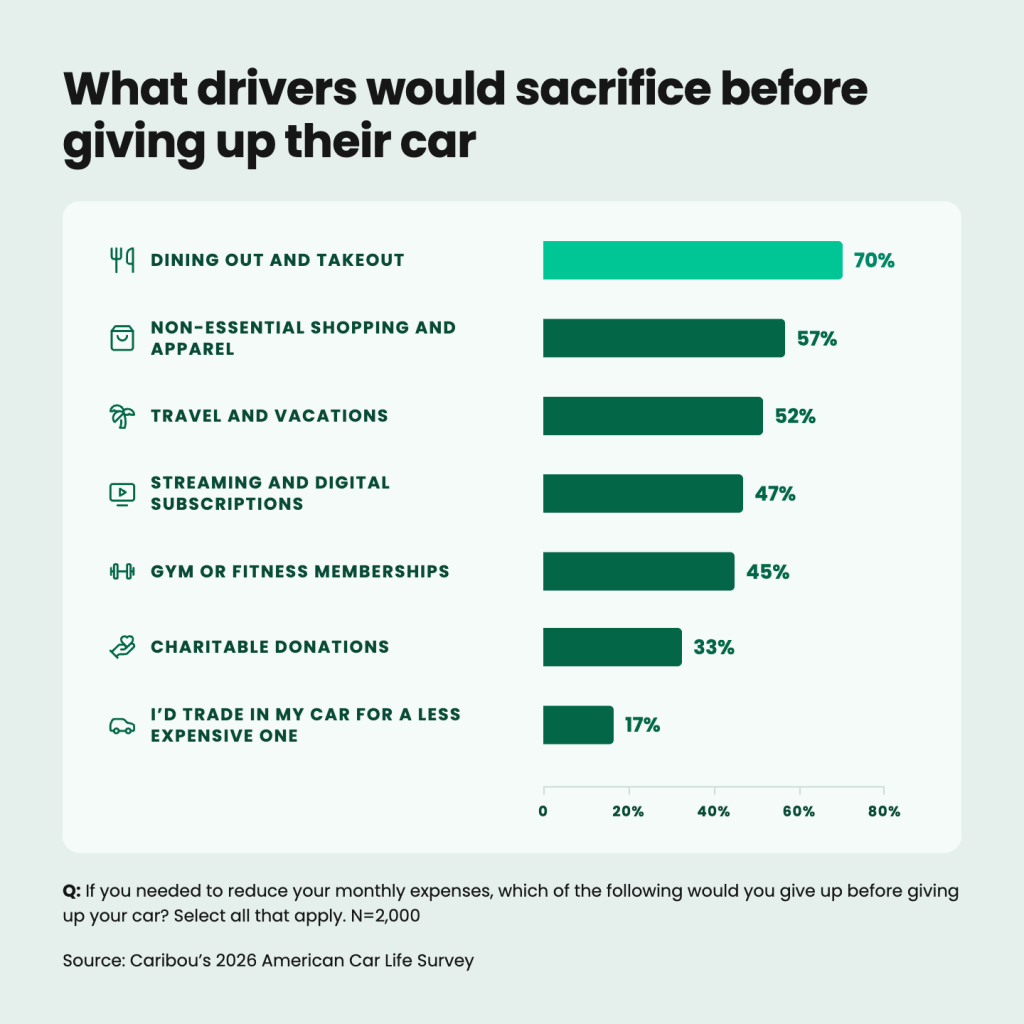
- Keeping their cars takes priority over other spending. 70% of drivers would give up dining out and takeout before their car, while more than half would sacrifice nonessential shopping (57%) or travel and vacations (52%).
- Drivers are willing to spend more for technology. 30% want as much in-car technology as possible, including optional upgrades and the latest features. Almost 3 in 4 (72%) would pay a monthly fee for at least one vehicle feature.
- For some drivers, their cars have taken on a life of their own. 29% talk to or about their cars as though they’re people, and 15% have given their vehicle a name.
Cars are deeply woven into American life. They’re how we navigate everyday responsibilities, and for many drivers, they also represent a source of freedom and personal expression.
But keeping a car on the road comes at a cost, and Americans are making difficult tradeoffs to manage it. Caribou’s new survey of 2,000 U.S. drivers with active car loans reveals just how much Americans are willing to sacrifice for their vehicles, alongside the personal attachment that makes car ownership so important to them.
High gas prices push drivers to rethink essentials and holiday plans
High gas prices are forcing adjustments well beyond the pump. Nearly all drivers surveyed (92%) reported taking at least one cost-cutting measure in the past six months because of fuel prices.
Most drivers looked for savings at the pump first. The most common steps were finding cheaper gas stations (43%), driving less (42%), and using fuel discounts or memberships (40%)—likely because these savings show up immediately.
Others have made more difficult sacrifices. More than 1 in 4 drivers (26%) have cut spending on groceries or household essentials to afford gas, while 22% have delayed vehicle maintenance or repairs. These tradeoffs show how transportation expenses can compete with other household necessities, sometimes at the risk of creating larger expenses down the road.

Despite these financial pressures, relatively few drivers have revisited one of their largest recurring vehicle expenses. While 22% have shopped for cheaper car insurance, just 9% reported refinancing their car loan as a cost-cutting measure, suggesting that drivers may be overlooking opportunities to meaningfully reduce their monthly car payments that could add up to several thousand dollars a year.
Fuel prices may also be influencing future vehicle preferences. Among gasoline and diesel vehicle owners, nearly half (48%) said gas prices have increased their interest in hybrids, compared with 38% who reported greater interest in fully electric vehicles.
Fuel costs are also reshaping the holiday season

The financial squeeze from high fuel costs is expected to extend into the winter holiday season. More than 3 in 4 drivers (78%) said fuel costs are changing how they spend this season.
Gifts take the biggest hit. Nearly half (44%) are spending less on gifts, while a third (33%) are buying for fewer people.
Holiday travel plans are also changing, reshaping a season built around getting together. About 71% of drivers are adjusting their plans, with 36% taking fewer trips and 24% skipping a trip they would normally take.
Even with these cutbacks, some households are turning to other financial resources to make ends meet. More than 1 in 4 drivers are relying more heavily on credit cards (26%) or dipping into savings (27%) to cover higher costs.
The findings suggest that the effects of high gas prices extend well beyond transportation budgets, potentially leaving some households with additional debt or less savings heading into the new year.
Drivers would sacrifice convenience and leisure to keep their cars
The willingness to cut back on groceries and holiday gifts reflects the essential role that cars play in American life. When asked what their car means to them, the most common response among a list of options was “necessity” (40%), followed closely by “freedom” (35%).
If they needed to cut monthly expenses, 70% of drivers said they would give up dining out and takeout before their car. More than half would sacrifice non-essential shopping (57%) or travel and vacations (52%), while 47% would give up streaming and digital subscriptions.
These priorities reflect the practical consequences of losing access to a vehicle. If they couldn’t drive for a month, nearly half (47%) said they would struggle to get groceries or other essentials, while 42% would miss work or lose income.
Car dependence can make transportation costs particularly difficult to reduce, even when household budgets are stretched thin.
More than transportation, cars are an extension of personal identity
While practicality may explain why Americans need their cars, it doesn’t fully explain the attachment many drivers have to them.
For some, a car is also a reflection of their personality. When choosing a vehicle color, personal style was the most commonly selected consideration (44%), ahead of factors such as cost (27%) and resale value (18%).
Their personal connection shows up in how Americans customize and interact with their vehicles. More than 4 in 10 drivers (43%) keep accessories or decorations in their cars, while 22% have customized or modified their vehicles.

Some take that relationship a step further. Nearly 3 in 10 (29%) admit to talking to or about their car as though it’s a person, and 15% have given their vehicle a name. Among the most popular names are “Betsy,” “Betty” and “Ruby.” More than just a label, these names often evoke a sense of nostalgia and familiarity.

Younger drivers are more likely than older generations to view their cars as a form of personal expression. Among Gen Z drivers, 30% have customized or modified their car, compared with 16% of Gen X and 7% of Boomers.
Whether it’s a customized interior or an affectionate nickname, these habits show how drivers make their vehicles their own. Cars aren’t just part of Americans’ daily routines. For many, they’re also a familiar space that reflects their personalities and accompanies them through life’s milestones.
Drivers want more car technology, and many are willing to pay for it
Even as Americans make financial sacrifices to keep their cars, many are willing to spend more on features that improve the driving experience.
Nearly 1 in 3 drivers (30%) said they want as much technology in their car as possible, including optional upgrades and the latest features.
The appetite for technology extends to paid subscriptions, an increasingly common approach among automakers offering connected services and software-enabled features. Nearly 3 in 4 drivers (72%) said they would pay a monthly fee for at least one vehicle feature, with in-car Wi-Fi, remote start or locking, and stolen-vehicle tracking among the most popular choices.
These preferences suggest that drivers place value on technology that makes their vehicles more convenient, connected and secure. But they also introduce another consideration in the cost of car ownership. As automakers expand subscription-based offerings, drivers may face additional recurring expenses beyond their car payments, insurance, fuel and maintenance.
The findings highlight an interesting tension: Americans are looking for ways to spend less on their cars while also embracing features that could make ownership more expensive.
Keeping the car without giving up life’s other big moments
The survey reveals how much Americans value their cars, even when ownership comes with difficult financial tradeoffs. To keep their cars running, drivers are cutting groceries, scaling back the holidays, delaying repairs and leaning on credit cards and savings.
These tradeoffs make it especially important to manage the cost of ownership. An existing car loan is one expense worth revisiting. Refinancing can potentially lower a driver’s interest rate or monthly payment, helping create more room in the household budget without giving up the car they rely on.
Methodology: Caribou’s survey was conducted from October 21-28, 2026 among 2,000 U.S. respondents to understand Americans’ relationship with their cars, including driving habits, fuel costs, and preferred car features and technology. All respondents currently have a car loan on their primary vehicle.